We use cookies to make your experience better. To comply with the new e-Privacy directive, we need to ask for your consent to set the cookies. Learn more.


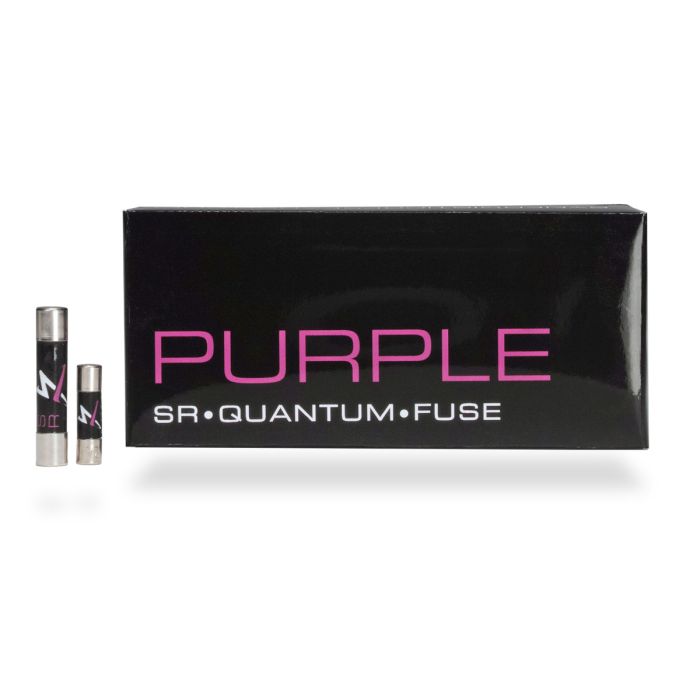
Quantum Purple Fuse (Small Slow Blow) **CLOSEOUT**
Special Price
$139.95
Regular Price
$199.95
The Purple Fuse surpasses SR's Orange Fuse with technology initially developed for their state-of-the-art SRX Series cables. In fact, before two last-minute breakthrough SRX technologies, they could not better the Orange Fuse with its impossible combination of detail and rich harmonic musicality. As a result, we were set to forgo a new fuse introduction for 2022 as we could not build anything better sounding than Orange despite two years of trying. It was not until we finalized two new technologies, namely a three-stage long duration high voltage conditioning process and a brand new UEF compound featuring Graphene, that we were able to beat the Orange Fuse significantly. Together these new technologies create a larger soundstage with better image focus and higher resolution from a perceived lowering of the noise floor. All aspects of subjective sound quality get enhanced, including natural sound where instruments and vocals sound inherently right, dynamics, low-level detail, high-frequency extension, and smoothness all take a massive leap forward.
How fuses alter the sound of your system. For over one hundred years people believed electrons flowed like water through a pipe and that once ‘contaminated’ by miles of wire, there was little or nothing that could be done to ‘clean’ the electricity feeding your components. Consider this: the electricity feeding your system’s components first propagates through a single fuse. This is why significant gains in sound quality are possible when you insert an SR Black or Blue Fuses into each of your components.
Today physicists understand electrons don’t flow at all but rather propagate in a wave of energy that moves along a conductor with a multitude of factors that alters this wave at the quantum level. To understand how electricity travels without electrons ever leaving their respective atoms it is helpful to consider the spectator ‘wave’ at a football match. Even though you can clearly see a wave pattern moving from spectator to spectator as fans raise and then lower their hands (without hands jumping from one person to the next), so too does electricity ‘move’ without electrons ever leaving their atoms. At Synergistic Research we’ve isolated key factors that affect how electricity propagates by changing the behavior of electrons through Inductive Quantum Coupling methods we collectively call UEF Tech. In fact, UEF Tech is so powerful even an electrical chain several miles long is fundimentally improved with nothing more than a single fuse engineered with SR's patented UEF Technology.
We get a lot of questions about fuses, so here are some answers!
I live in the US and I don't speak millimeters, how can I tell what size my fuse is?
This one's easy! Grab a quarter coin and lay your fuse across the center of it. If the fuse doesn't hang over the edge of the quarter, it's a Small. If it does, it's a Large. Since those are the two primary sizes of fuses used on gear made in the last 25 years or so, you have now correctly sized your fuse! However, if you have a really tiny fuse about half the size of a quarter or a chunky fat one thicker than a Crayola crayon, let us know, we will need to ask you some questions.
All Small fuses are sized as 5x20mm (roughly 0.2x0.79")
All Large fuses are sized as 6.3x32mm (roughly 0.25x1.26")
I'm looking at my fuse, but, there's an alphabet soup of letters and numbers! How do I figure out what value I've got?
What you're looking for will be embossed on one of the metal end-caps of your fuse. There's likely a bunch of other printing on the end caps, some of which indicate the brand and perhaps the fuse type (e.g. AL). None of that is important. What you're actually looking for is a number with a letter in front of it and an A right after it. The letters "T" and "L" are used to indicate Slow blow and this is most likely what you have as about 80% of the fuses we sell are Small and Slow. However, if you see an F, that's for Fast blow and these two shouldn't be interchanged. More on this later.
Example: A magnifying glass is likely to come in very handy here, so it's worth it to grab one before attempting to read the value. Let's say the reading on the fuse is T2A. That is a Slow, Two Amp fuse. F8A would be a Fast Eight Amp fuse. The only tricky ones are the tiny values where there's a lower case m in front of the A. For instance a T250mA fuse, would be a Slow 250 milliAmp fuse. However, you might also see that exact same value written as T0.25A. We think this is obnoxious and unnecessarily confusing and should be outlawed. Can't figure it out? Write it all down and call us, we can walk you through it!
What's the difference between Slow Blow and Fast Blow?
A Slow blow fuse is designed to withstand its full rated value for a short period of time, allowing the gear to temporarily achieve peak current draw. This is important right at startup, when the component is slurping current and trying to fill its power supply. However, after that instantaneous surge, the current flow will subside dramatically. Manufacturers will indicate a Slow blow fuse for this, because it makes the fuse less twitchy. On the other hand, a Fast blow fuse will "pop" immediately as soon as the current draw matches the fuse's rating, instantly protecting the circuit. Again, about 80% of the fuses we sell for modern components are Slow blow.
What's the deal with "uprating" the fuse value? My salesman mentioned doing this, is it safe?
This is such a big deal that we've actually included a special tab about it above! Long story short, if you've got a Slow Blow fuse, yes, it's safe to move up to the next value. However, if you have a Fast Blow fuse, we do not recommended uprating.
My fuse is rated for 120V, is it safe to use one that has a higher voltage rating?
Absolutely. When it comes to fuses, the voltage rating is the maximum voltage the fuse can withstand before it pops to protect the circuit. This has very little bearing on the protection offered. This also means that standard household voltages of 100V, 120V even 240V will not pop the fuse. There is no danger in replacing your lower voltage fuse with a higher voltage fuse.
• All Small fuses are rated for a maxmum of 250V
• All Large fuses are rated for a maximum of 500V
I live in the UK and I want to swap out the fuse on my power cord, do you sell replacement values for this?
We sure do! Simply select the UK Fuse option from the dropdown! They're only available in one size and speed, so there's no need to agonize over whether you've made the right choice. You have!
Do you know what fuse X or Y component takes?
No, we don't keep a database of fuse values. This is mostly because manufacturers have a bad habit of making running changes to their units and then neglecting to inform the population. That being said, if the fuse itself is accessible from the outside, manufacturers will silk-screen the required fuse value on the rear of the component, right near the fuse holder. One tricky thing about this, there are usually two values printed, one for 120V operation and another one for 240V. Be sure to pick the correct value for your wall voltage! If the value isn't printed on the rear, you may have to open the top to get into the unit and find your fuse. These are usually found on the power supply board, sometimes they're exposed, sometimes they're protected by a rubber jacket or a plastic covering. The nominal value is usually printed on the circuit board right near the fuse, but it's always worth it to check the installed value. Besides, you're going to have to pop the old fuse out when you get your new one anyway, so, now's a great time to simply lay hands on your fuse and make sure you've got the right one!
Fuses are used because their protection against excess voltage or drawing too much current. They are cheap to implement with bulk prices usually only a few pennies, yet they're very effective in preventing "runaway" damage to your gear. Should an internal component fail or the voltage or current on the line get too high, the filament wire in the fuse will "burn" thus interrupting power and protecting the gear.
For a fuse to protect a component, every single electron the component uses must travel through that fuse. However, this is where the problems start. To keep prices low, fuse manufacturers use thin glass, aluminum end caps and aluminum burn wire. Glass is horribly resonant, and aluminum is a terrible conductor. This means generic fuses are a "worst case" scenario for any component!
Audiophile fuses are constructed with high-grade materials. For instance, they will use Copper or Silver for the endcaps and burn wire. These metals offer much higher conductivity and lower distortion for a huge improvement in tonal quality and dynamic range. Ceramic bodies reduce vibration from what would otherwise be a tensioned filament drawn between two fixed poles, aka a guitar string. This alone can be a jaw-dropping improvement, but the best fuses go even further, adding internal vibration control to keep resonance down and the best ones enhance conductivity using various chemical and/or electrical treatments.
Audiophile fuses are vastly more conductive than generic fuses and they're built to far tighter tolerances. This makes them a lot more precise than an aluminum fuse and way more sensitive. Most audio gear wasn't designed with such a high level of fuse precision in mind, which is why we almost always advocate "uprating" the fuse. This means selecting the next higher value fuse, for example if you had a 1A fuse you would move up to a 1.25A fuse.
Although this might sound dangerous, in fact it isn't. Moving up to the next available value of an audiophile fuse simply puts the protection in-line with the manufacturer's expectations and keeps your brand-new high-performance fuse from popping the moment you power up the unit!
NOTE: The sole exception to our "uprating" recommendation is Fast Blow fuses. Slow Blow fuses allow the component to temporarily reach the fuse's max rating without blowing, which makes these fuses fairly tolerant and safe for uprating. Fast Blow fuses, on the other hand, are primarily used in situations where any current at or above the rating might damage the gear. A prime example of this is Magnepan speakers which have "fused" tweeter and midrange panels. Even a short burst of excessive power from the amplifier could damage the panel, in that instance, a Fast Blow fuse would blow immediately thus protecting the panel from damage.