We use cookies to make your experience better. To comply with the new e-Privacy directive, we need to ask for your consent to set the cookies. Learn more.


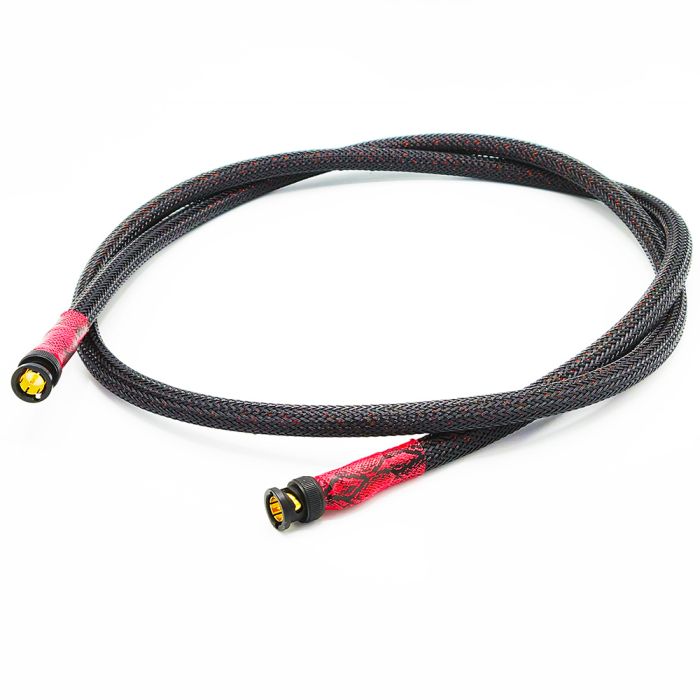
The Takshaka Digital SPDIF cable was built from the ground up to preserve timing accuracy and protect the integrity of the digital signal.
Snake River Audio took the lessons learned from designing their award-winning Boomslang cable and combined them with solid foundational coaxial knowledge to create something greater than the sum of its parts.
It is not coaxial. It is not parallel. It is Takshaka.
The Hanging Faraday™ shielding protects the signal path and helps create an exceptionally black background.
The result is improved timing stability, strong image placement, and an incredibly wide open presentation that remains musical and composed.
Hanging Faraday™ Shielding
Many conventional shielded cable designs tie the shield into the signal circuit at both ends. While common, that approach can raise return-side capacitance and alter impedance behavior.
This can be compared to walking down the sidewalk to the store, then having to slog through a swamp on the way home. The trips are not equal. The path is imbalanced. That imbalance can create problems.
Snake River Audio's Hanging Faraday™ instead isolates the shield electrically while still enclosing the conductors, functioning like a Faraday cage that blocks external interference without loading the transmission path.
The Science Behind Digital Cable Length
For more than a decade Snake River Audio has maintained that 1.37 meters (about 54¼ inches) is the minimum effective length for SPDIF and AES/EBU digital cables. This is physics, not marketing. At shorter lengths, reflections from impedance mismatch can land during the receiver’s vulnerable timing window and raise jitter.
Digital audio links carry fast edges. Once a square wave leaves the source it behaves like RF on a transmission line. Two facts set the problem:
- Characteristic impedance: 75 Ω for SPDIF coax, 110 Ω for AES/EBU twisted pair. Real connectors, transformers, PCB stubs, and jacks rarely match this perfectly.
- Propagation velocity: signals travel at ≈0.66c, or about two-thirds the speed of light, in common dielectrics for both 75 Ω coax and many 110 Ω pairs.
Any mismatch at the load sends a reflection back to the source. The first echo returns after the round-trip delay
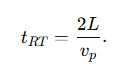
If that echo arrives within roughly a few rise times of the original transition, it perturbs the threshold crossing at the receiver and increases timing uncertainty. Pick the length so the echo lands after the receiver’s critical window.
Typical consumer transmitters show rise times near 4–6 ns. Setting t R T ≈ 12 – 15 t R T ≈12–15 ns is prudent. With v p ≈ 0.66 c v p ≈ 0.66c, this yields L ≈ 1.2 – 1.5 L≈1.2–1.5 m. The long-used 1.37 m sits in the center of that range and works well across real-world gear.
Eye quality in plain language
Engineers judge signal integrity with an eye diagram. Stack many bits on top of each other and you see an “eye” shape. A wide, open eye means stable timing and clean levels. Early echoes narrow the eye and make the slicer guess. Pushing the first echo outside the receiver’s aperture re-opens the eye and lowers jitter.
The train and tunnel analogy
Picture the digital signal as a train and the cable as a tunnel. The goal is for the entire train to be inside the tunnel before the engine reaches the far end. If the tunnel is too short, the engine comes out the other end before the caboose has entered, meaning part of the train is still outside while the front is already exiting. That overlap is like a signal reflection arriving back at the source before the original transmission has fully cleared, two versions of the same event colliding. A longer tunnel, or in this case a longer cable, ensures the reflection arrives only after the original signal has finished its trip.
Why this holds in real systems
Perfect matching is rare:
- SPDIF: RCA jacks and adapters are seldom true 75 Ω through the pin–dielectric–shell geometry.
- AES/EBU: XLR connectors are not controlled-impedance devices; only the cable is nominally 110 Ω.
- Interfaces: Pulse transformers, small PCB stubs, and protection parts add discontinuities.
These common imperfections make a timing-based length rule useful. ~1.37 m or longer moves the first echo out of harm’s way on most links with no downside at home-audio lengths.
Scope and limits
- Receiver variance: Good PLLs and slicers can tolerate more. The 1.37 m rule is a robustness recommendation, not a law.
- Very long runs: Long cables add attenuation and dispersion that also close the eye. For home systems, 1.3–3 m is a safe region.
- AES/EBU parity: The same timing math applies to 110 Ω AES/EBU. Many 110 Ω pairs run v p = 0.66 – 0.75 c v p =0.66–0.75c. A 1.3–1.5 m minimum provides similar echo timing.
Bottom line
In typical real systems with imperfect 75 Ω or 110 Ω matching, cables shorter than roughly 1.2 m are more likely to let the first reflection overlap the transition edge. Setting a minimum of 1.37 m adds clean timing margin and improves eye quality. This is why every Snake River Audio SPDIF and AES/EBU cable honors that minimum.
It basically comes down to a math problem. Every digital cable out there, regardless of the manufacturer, should follow this. Physics does not care about brand.
Congrats, this product is FREQUENT FLYER ELIGIBLE
If you're interested in more products that are Frequent Flyer Eligible just look for this icon or use the SAVINGS filter when searching for products.
Our "Frequent Flyer" Program offers pricing and/or freight incentives for any order over $100 domestically ($300 internationally). Frequent Flyer is a cumulative program, so you will get credit for all previous orders each time to place a new order! With us, everyone’s a Frequent Flyer - no prior signup needed. After you place an order for Frequent Flyer eligible products, we will calculate applicable incentives. Your order amount will be adjusted and we will confirm the calculations by email within one business day. Click for more details.
| When your order totals (including current transaction) are: | Incentive (Except for Used or Specials) |
|---|---|
| $0 - 49 | 0% Discount. Customer pays freight guidelines |
| $50 - 199 | 0% Discount. See free freight guidelines |
| $200 - 599 | 5% Discount. See free freight guidelines |
| $600 - 699 | 6% Discount. See free freight guidelines |
| $700 - 799 | 7% Discount. See free freight guidelines |
| $800 - 999 | 8% discount. See free freight guidelines |
| $1000 - 1499 | 9% discount. See free freight guidelines |
| $1500 - 1999 | 10% discount. See free freight guidelines |
| $2000 - 2499 | 11% discount. See free freight guidelines |
| Over $2500 | 11.5% discount. See free freight guidelines |