We use cookies to make your experience better. To comply with the new e-Privacy directive, we need to ask for your consent to set the cookies. Learn more.


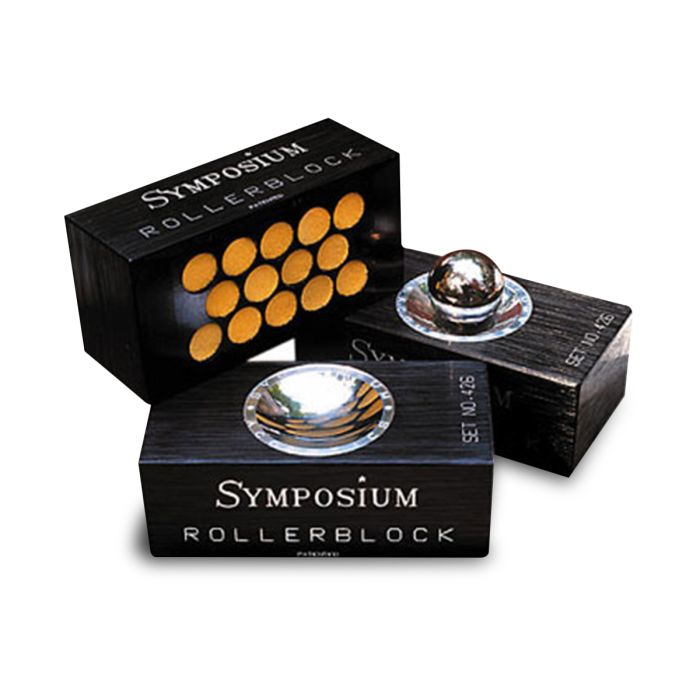
Symposium Rollerblock Series 2+ is an equipment support system providing simultaneous coupling and decoupling of audio and video equipment. When properly installed, a set of Rollerblocks can increase overall system performance by an order of magnitude similar to a wholesale upgrade of the component it treats.
Utilizing technology employed in earthquake protection and combining it with proprietary mechanical transmission techniques, Rollerblocks are the most sonically beneficial coupling devices available. Used beneath digital equipment, DVD players, preamplifiers and other components, results can be nothing less than astonishing. Increased focus, soundstaging, image stability, dynamics and delicacy are just a few of the sonic delights awaiting the serious audiophile. When used with an effective equipment base (such as Symposium Platforms), the Series 2+ Rollerblock system provides an additional step toward ideal equipment support, which is simultaneous component isolation and drainage of chassis-borne vibration.
Symposium Rollerblock Series 2+ systems achieve their seemingly "magical" results by obeying laws of physics. Their strict manufacturing tolerances (much higher than usually found in an audiophile "tweak" device) are responsible for their world-wide reputation as the first and best ball-bearing isolation device available. Professional reviewers and private owners alike are emphatically enthusiastic about how Rollerblocks enhance and improve the performance of virtually any component, including CD players, DVD players, digital transports, preamplifiers, amplifiers, and more.
Beginning November 1, 2004, all standard Tungsten Carbide balls are Grade 10 precision. State-of-the-art precision Grade 2.5 Superballs are available as an optional upgrade or included with the Series 2+G3 set.
Rollerblocks deliver impressive sonic improvements with virtually any component, however, for the most dramatic results we recommend first starting under source components, such as DACs, Streamers, Disc Players or Phono Preamps. This allows every component in the signal chain to benefit from a resonance free platform, allowing the system to remove the constricting ofdynamics, transient response, and overall "air" and clarity.
The reduction of vibration and its effects upon audio and video components draws the system a significant step closer to optimal performance. The most highly reviewed footer device in the world is not really an accessory, Rollerblocks must be considered an essential component of any high performance system. As one reviewer put it, "Symposium Rollerblocks function just like a component, {they will} stand the test of time for they will never become obsolete."
Improvements in sound and picture quality are accomplished by reducing noise in the component (caused by vibration) which the Rollerblocks drain away without introducing any new resonances or distortions, or changing tonal character of the component. Rollerblocks dissipate mechanical energy (aka vibration) which originates from the component itself, while simultaneously providing isolation from external vibration. This specialized, two-pronged attack on vibratory energy distinguishes the Symposium Rollerblock systems, and is responsible for their unsurpassed effectiveness and performance.
The strength of the Series 2 Rollerblock is its simple yet effective design. They are small enough to be unobtrusively inserted into any system with a minimum of fuss and setup, and require little or no maintenance or adjustment. Unlike "flat race" devices, Rollerblocks are inherently self-centering and do not require that the component or the support surface be level, or that the surfaces even be parallel! If the component is touched or moved, the Rollerblock 2s will simply return to their center position and not bind up.
Vibration affects the performance of electronic components, usually with negative results, and originates from sources outside or inside the component. Rigid supports such as cones or spikes provide an escape route (in essence, a mechanical "ground" connection) for vibration that is more efficient than the typical rubberized feet of most components. These cone devices work by acting as a crude "waveguide" for mechanical energy, funneling energy to a point and forcing it to encounter the support structure at an angle of 90 degrees, the optimum approach angle for energy transfer (please see our web page on the nature of equipment cones in the "Our Technology" section for a more comprehensive discussion of how and why they work). While there are some directional characteristics to these devices in that more energy can flow from the large area side to the point side than the reverse, they are unable to isolate or absorb low frequency waves, as these readily traverse the pathway, moving the support structure, the cones, and ultimately the component.
Symposium Rollerblock systems (both the Series 2 as well as the entry-level Rollerblock Jr. fulfill this seemingly contradictory condition by combining a ball with a receptacle optimized for vibration transmission - the Rollerblock body. Precision machined from hard metal, it makes an excellent conductive path for vibratory energy, one far superior to woods, plastics, or rubber. The matrix on the Series 2 body bottom relegates surface contact to the ridges between the holes (with increased pressure) and serves as a mechanical waveguide. Vibratory energy travels through the steel ball, then the block body, and is "guided" down irregularly shaped pillars of metal (the "honeycomb" matrix). The energy is able to pass into the support structure at multiple points and at a more optimal angle, and this enables it to more efficiently penetrate the supporting surface. Acoustically absorbent material in the holes dissipates some of this energy as heat, and eliminates any resonances which might be caused by the hole cavities. Early experiments in different systems confirmed the effectiveness of the matrix to improve performance.
Low frequency waves coming from the component's structure cause physical displacement of the ball and the Rollerblock body. As this "microearthquake" occurs, the captured ball in the Rollerblock's cup rolls - or "slips" - between the Rollerblock body and the equipment chassis. As the Rollerblock body moves, it pushes the ball and the component up the sides of the cup, dissipating the energy as work. At all times, however, there is contact between the component chassis and the Rollerblock body through the bearing, providing an unbroken, constant-metal drainage path for vibration otherwise trapped in the component, even while it is "decoupled" and able to move relative to the support.
The rolling, rigid, single ball-bearing contact, mated to a receptacle optimized for mechanical energy transmission, effectively achieves a dual coupler/decoupler design in a simple, elegant solution. This design is patented.
Rollerblocks vs Rubber Feet, Rubber Balls and Sorbothane Pads
Low-frequency external vibration, including footfalls, sound, or shock waves from loudspeakers or other sources, can be reduced by introducing a high compliance between the component and the support, such as rubber air bag devices, or very soft, compliant materials, such as sorbothane rubber. While these devices seek to decouple the component in a crude approach to "isolation," they trap vibrations in the component itself by closing off its drainage path. In other words, what can't come in also can't get out. Worse, rubber-like materials store and release energy back into the component, and usually worsen results with a new source of secondary vibration.
Thus, it is desirous to isolate the component, but at the same time provide an escape route for internal vibration. Buzzing transformers, CD servo and disk motors, or even junctions of "singing" solid state devices (caused by the heat expansion and contraction of elements subjected to high current densities) can all be sources of internal vibration. By efficiently coupling the component's chassis to a non-resonant drainage sink, or mechanical "ground," we can provide an escape route for this vibration. The conduit for vibration flowing out of the component must be rigid, since flexible materials don't transmit energy well. But, since we also want to isolate the component from external vibration, this support must also be flexible. These requirements are mutually contradictory - akin to a "soft hardness!"
Tungsten Carbide
This material is greatly preferred for the ball material of the Rollerblock systems, providing far superior results to steel (chromium or stainless), brass, glass, or even ceramicThis has to do with Tungsten Carbide's unique combination of extreme hardness and high mechanical transmissivity. This ability to act as a mechanical conductor at higher frequencies, is very close to that of aluminum, delivering a coherent, reflection-free transmission path for vibration and an excellent match to the Rollerblock's aircraft-grade aluminum body. By comparison, Ceramic, which exhibits excellent hardness, does not transmit energy nearly as well as Tungsten Carbide. Heat transmission is a direct indicator of a material's ability to transmit mechanical vibration and Ceramic's poor heat transmission capability makes it unsuitable as a mechanical ground linkage in a ball bearing isolation device.
The Series 2 Rollerblock body is made from solid, rectangular blocks of extremely hard alloy aircraft aluminum, and are finished with a black "hard-coat" anodizing. This relatively thin, special layer, harder than the aircraft aluminum itself (which is harder than some types of steel), improves contact efficiency and provides "constrained layer" resonance damping to the body. The bottom of the Series 2 Rollerblock has four beveled edges, and a matrix consisting of a pattern of holes. This unique design improves mechanical coupling between the body of the block and the supporting surface, like a cone, but with much greater stability. The matrix is filled with an acoustically absorbent material. On the top surface is a precision, spherical depression which is polished to a mirror finish, specified at 6 microns or better. This is an especially good finish, difficult to manufacture with precision. It is absolutely necessary, however, for state of the art results in a bearing isolation device.
Each precision ball rests at the bottom of the cup depression in the Rollerblock body. At least three Rollerblocks are placed beneath a component so that the component's chassis contacts the tops of the three balls, which now function as bearings. The component rests directly or indirectly upon the ball bearings, which rest at the bottom of the polished cup.
Dimensions(WDH): 2x1x0.75"
Height With Ball Bearing: 1.125"
Stainless Plate: 1/16" (Included)
Total Height: 1.1875"
Congrats, this product is FREQUENT FLYER ELIGIBLE
If you're interested in more products that are Frequent Flyer Eligible just look for this icon or use the SAVINGS filter when searching for products.
Our "Frequent Flyer" Program offers pricing and/or freight incentives for any order over $100 domestically ($300 internationally). Frequent Flyer is a cumulative program, so you will get credit for all previous orders each time to place a new order! With us, everyone’s a Frequent Flyer - no prior signup needed. After you place an order for Frequent Flyer eligible products, we will calculate applicable incentives. Your order amount will be adjusted and we will confirm the calculations by email within one business day. Click for more details.
| When your order totals (including current transaction) are: | Incentive (Except for Used or Specials) |
|---|---|
| $0 - 49 | 0% Discount. Customer pays freight guidelines |
| $50 - 199 | 0% Discount. See free freight guidelines |
| $200 - 599 | 5% Discount. See free freight guidelines |
| $600 - 699 | 6% Discount. See free freight guidelines |
| $700 - 799 | 7% Discount. See free freight guidelines |
| $800 - 999 | 8% discount. See free freight guidelines |
| $1000 - 1499 | 9% discount. See free freight guidelines |
| $1500 - 1999 | 10% discount. See free freight guidelines |
| $2000 - 2499 | 11% discount. See free freight guidelines |
| Over $2500 | 11.5% discount. See free freight guidelines |