We use cookies to make your experience better. To comply with the new e-Privacy directive, we need to ask for your consent to set the cookies. Learn more.


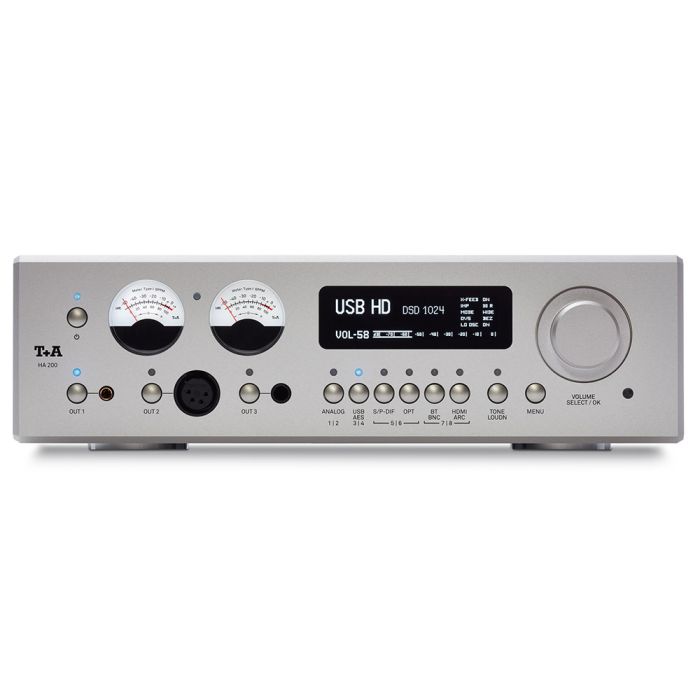
T+A’s first headphone amplifier is a ground-breaking development in which the analogue amplifier section, converter section, and chassis construction are all designed for optimal performance.
The analogue stage of the HA 200 is based on T+A’s HV technology. Its high-performance Class A output stages operate with high idle current and are capable of driving even demanding headphones with ease. The impedance of the three headphone outputs can be adapted to match the headphones in use as well as individual sonic preferences. A selectable crossfeed function is also available, designed to create a more natural soundstage presentation with a speaker-like positioning in front of the listener.
The power supply section consists of separate analogue and digital supplies, each supported by its own toroidal transformer, providing substantial power reserves and stable operating conditions.
On the digital side, the HA 200 is equipped with T+A’s proprietary converter architecture. The True 1-Bit DSD converter supports native processing up to DSD1024, while the PCM stage employs the quadruple converter architecture with 32-bit resolution and support for up to 768 kHz. As with all current T+A digital-to-analog systems, a fully separate decoding architecture is used for PCM and DSD, ensuring each format is processed under optimal conditions.
The mechanical design and materials are closely aligned with the electronics. The HA 200 is significantly larger and heavier than conventional headphone amplifiers, reflecting the complexity of its internal architecture, which comprises more than 2,300 individual components. All chassis elements are manufactured from non-magnetic aluminium, with the front panel milled from solid material in a design consistent with the HV series.
A precision QPPM meter display and a high-resolution screen provide detailed system information and operating status. All functions can be controlled via the FM8 infrared remote control.
The HA 200 has been designed without compromise, with the sole objective of achieving the highest possible standard of musical reproduction.
The amplifier section plays a crucial role in the overall design. For this reason, T+A adopted the principles of the HV series: a fully analog Class A design using special MOS-FET transistors, with no operational amplifiers or integrated circuits, and a separate 100-watt analog power supply section.
Even the crossfeed function is implemented using an analog filter circuit. The XLR and RCA inputs follow the same high-quality design principles as the HV series, and the preamplifier stage is engineered to drive the output stage under optimal conditions.
Gas-tight, encapsulated gold-contact relays handle volume control and the adjustable loudness function, and can fully bypass the tone control section (flat) when required. These relays operate without distortion or noise and remain reliable over long-term use, as they are protected against corrosion, dust, and aging effects. Integrated directly into the signal path, they ensure extremely short signal routes.
To accommodate a wide range of headphone types, the output stage was designed with exceptional flexibility and performance. While conventional loudspeakers typically operate between 2 and 10 ohms, headphones can range from 10 to 1000 ohms, presenting a significantly more complex load scenario. Low-impedance headphones require high current delivery, whereas high-impedance designs demand very stable voltage levels with lower current draw.
T+A addressed this challenge by designing an output stage capable of delivering high current effortlessly, supported by a highly stable dual-transformer power supply (2 × 50 watts), ensuring consistent performance across all load conditions.
The wide range of connection facilities requires a highly sophisticated control and display system for the amplifier as a whole. The HA 200 remains intuitive and straightforward to operate, thanks to an intelligent combination of physical operating buttons and a structured menu control system.
The two VU meters (QPPM = Quasi Peak Programme Meter Type 1) provide precise visual monitoring of key signal parameters, comparable to those used in studio and measurement applications. They display variations in level across the D/A converter and amplifier stages, as well as input and output levels, temperature, and stream quality. Stream quality monitoring can also be used to assess data rate stability and, in certain cases, cable quality.
A high-resolution display shows selected operating modes, including output impedance, volume level, data rate, oversampling filter type, and crossfeed settings. The brightness of the display, LEDs, and VU meters can be individually adjusted, including color customization to suit user preference.
Since T+A designed the HA 200 for use in professional applications, the chassis is engineered to be exceptionally solid and robust. The heatsinks are produced using an extrusion process, the front panel is machined from solid metal, and the top, bottom, and rear panels are manufactured from precision-machined aluminum plates.
Ultra-tight tolerances and precise fitment define the construction of the enclosure. At the same time, the design promotes efficient and uniform heat distribution, ensuring optimal operating conditions for the internal electronics as a whole.
Sound quality can be fine-tuned by selecting different output impedance settings for each output (6.3 mm, 4.4 mm Pentaconn, and 4-pin XLR). A crossfeed mode is also available for improved spatial imaging when desired. The 4-pin XLR output can additionally be used to drive loudspeakers when the user connects a suitable stereo power amplifier (such as the AMP 8). In this configuration, an XLR-4 to dual RCA adapter can be provided if required.
In addition to conventional high-quality analog inputs, the HA 200 also features a wide range of high-quality digital inputs, enabling standalone operation and flexible integration with various digital sources. The digital input section is designed to meet the highest performance standards. The USB-B input is based on a high-resolution Thesycon platform capable of processing up to DSD1024 and PCM 768. Professional AES/EBU and BNC inputs are also provided, along with optical and coaxial S/PDIF connections. Bluetooth with aptX™ HD is included, and two HDMI inputs (stereo only) as well as an HDMI ARC output are available as optional features.
Signal integrity is maintained throughout the conversion stage. The HA 200 incorporates T+A’s proprietary True 1-Bit DSD digital-to-analog converter, supporting native DSD processing up to DSD1024, alongside the PCM quadruple converter architecture with 32-bit/768 kHz capability. These technologies reflect current state-of-the-art digital audio conversion and define the upper limits of contemporary implementation.
The digital section is powered by a dedicated supply and is galvanically isolated from the analog circuitry to minimize interference between domains.
Although the HA 200 is fundamentally designed as a high-performance amplifier, this extensive input flexibility provides significant practical advantages for a wide range of applications. By employing T+A’s highest-quality DSD and PCM conversion technologies, the sonic performance of the digital inputs is maintained at a level equivalent to that of the analog inputs.
Analogue section
- Frequency response + 0 / − 3 dB: D0,1 Hz – 200 kHz
- Signal / noise ratio: 110/114 dB
- THD / Intermodulation: < 0,001 % / < 0,001 %
- Channel separation: > 108 dB
- Class A operation: up to 700 mA
- Loudness: switchable, adjustable on the speaker efficiency
- Sound control: switchable, channel separated. Bass and treble -6 dB to + 8 dB
- Headphone outputs: 6.3 mm plug, 4.4 mm Pentaconn, XLR-4 pin; Impedances: 8, 12, 18, 25, 40, 80 Ohms
Analogue inputs
- High level (RCA) / balanced (XLR): 250 mVeff ... 4,5 Veff / 10 kOhms | 500 mVeff ... 9 Veff / 20 kOhms
- Channel separation: 110 dB
Digital inputs
- 1 x AES-EBU 32...192 kHz / 16-24 Bit
- S/P-DIF: 2 x Standard Coax, 2 x optical TOS-Link 32...192 kHz / 16-24 Bit,
- 1 x BNC 32...192 kHz / 16-24 Bit,
- 2 x USB DAC: Device-Mode 44,1 ... 768 kSps (PCM) and up to DSD1024*, supports asynchronous data transfer. *DSD 512 and DSD 1024 with Windows PC and appropriate driver installed or Linux PC with Kernel 4.4 or higher only. Supports DoP up to DSD 256 (0x05/0xFA Marker).
- 2 x HDMI IN, 1 x HDMI OUT with ARC (as an option)
Bluetooth
- A2DP (Audio), AVRCP 1.4 (Control) / aptX® HD , SBC, AAC
D/A converter section
- PCM: Double-Differential-Quadruple-Converter with four 32-Bit Sigma-Delta D/A converter per channel 705,6 / 768 kSps conversion rate
- DSD: T+A-True-1Bit DSD D/A converter, up to DSD 1024 (49,2 MHz), native bitstream
Upsampling: T+A signal-processor – synchronous upsampling with four selectable oversampling algorithms. FIR short, FIR long, Bezier/IIR, Bezier, NOS (non-oversampling))
Analogue filter: Phase-linear Bessel filter 3rd order, switchable with 60 or 120 kHz cut off frequency
Mains / Accessories / Dimensions
- Mains: 100 – 120 V or 200 – 240 V, 50 – 60 Hz, 100 Watts
- Standby: < 0,5 Watts
- Dimensions (H × W× D): 10 × 32 × 34 cm, 4 x 12.6 x 13.4 inch
- Accessories: Remote control FM8, power cord, USB-cabel for charging RC, USB cable 2.0 for DAC, RCA cable
- Weight: 6,5 kg, 14.4 lbs
- Finishes: Alu silver anodized (43), Alu black anodized (42)
Technical modifications reserved
"MAP" products are not Frequent Flyer eligible.
The pricing indicated is the absolute lowest allowed by the manufacturer. Our "Frequent Flyer" Program offers pricing and/or freight incentives for any order over $100 domestically ($300 internationally). Frequent Flyer is a cumulative program, so you will get credit for all previous orders each time to place a new order! With us, everyone’s a Frequent Flyer - no prior signup needed. After you place an order for Frequent Flyer eligible products, we will calculate applicable incentives. Your order amount will be adjusted and we will confirm the calculations by email within one business day. Click for more details.